How to stop overthinking and handle stress: Dr. Elissa Epel's tools on Huberman Lab
A 30-minute Huberman Lab episode with stress scientist Dr. Elissa Epel, summarised: key takeaways, chapter guide and small steps to try today.
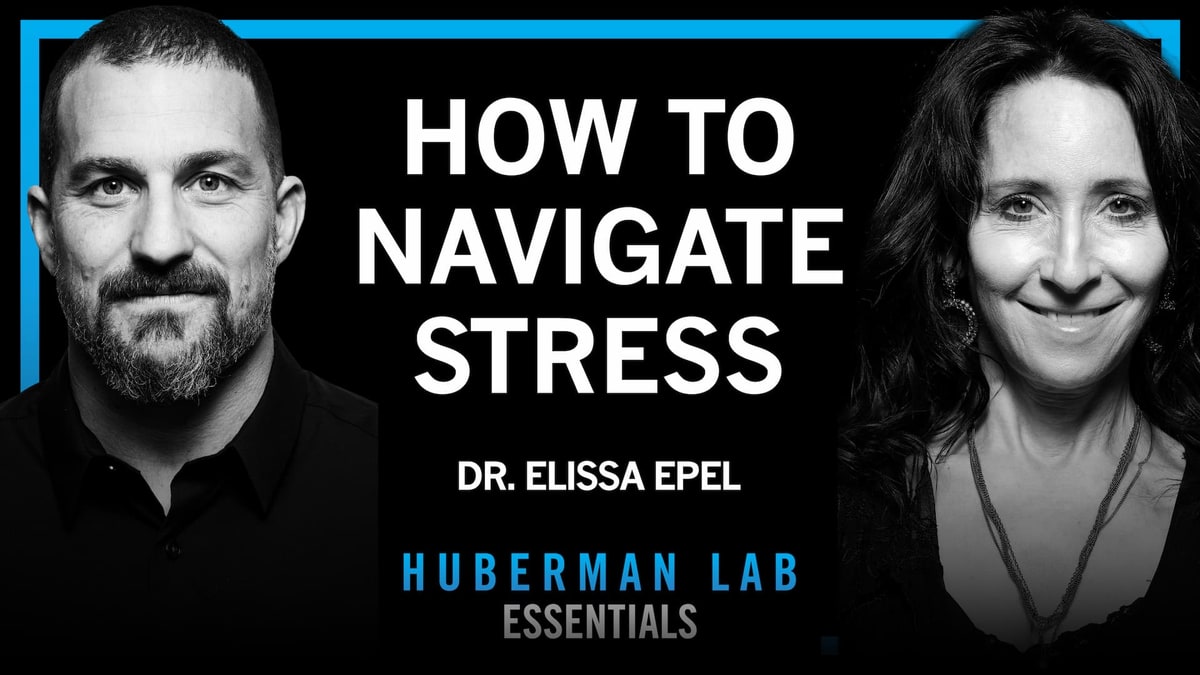

Stress is not the enemy, says Dr. Elissa Epel, a psychiatry professor at UCSF who has studied it for decades. The trouble starts when it never switches off. In this half-hour Huberman Lab Essentials episode, a shorter cut of her full 2023 conversation with Andrew Huberman, she explains why and gives practical tools you can use the same day. The full episode is above.
Key takeaways
- Most stress lives in our thoughts. Epel says replaying a problem keeps the stress alive long after the moment has passed.
- Notice your body first. Clenched hands, tight shoulders, a held breath: spotting the tension is, in her words, “step one to releasing it.”
- Short stress can help you. A burst of stress gives energy and focus. What harms us is stress that never gets a recovery break.
- Threat or challenge? The same situation can feel like a threat or a challenge, and the body reacts differently to each (more below).
- Build your “stress shields”. Remind yourself of your resources, past wins and the people who can help.
- Stop fighting what you cannot change. Epel calls this radical acceptance, and uses the image of dropping a rope in a tug-of-war you can’t win.
- Slow breathing is the fastest body-based tool, and a sense of purpose protects us over the long run.
What the episode covers
- 0:22 Good stress, bad stress, and how the body responds
- 1:55 Rumination, and why body awareness helps
- 3:23 Three kinds of tools: mindset, body and environment
- 4:51 Acute vs. chronic stress, and why recovery matters
- 9:27 Healthy ageing, purpose and the brain
- 10:54 Resilience: the threat vs. challenge response
- 14:40 Reframing stress and “stress shields”
- 18:30 Mitochondria, caregiving and daily mood
- 21:24 Chronic stress and radical acceptance
- 25:19 “Drop the rope”: stress you cannot control
- 26:48 Uncertainty, posture and slow breathing
- 30:34 When to take action and when to let go
- 32:55 Journaling, your life story and purpose
Threat vs. challenge: the idea at the centre
When something feels like a threat to your safety or your self-image, Epel explains, blood vessels tighten, cortisol stays high and you recover slowly. When the same event feels like a challenge, your heart pumps more blood, your brain gets more oxygen and you think more clearly.
In lab studies she describes, people with a challenge response showed less inflammation afterwards. The good news is that the switch is partly in our hands.
Stress shields and reframing
Before a stressful moment, such as an exam, an interview or a hard conversation at home, Epel suggests telling yourself things you actually believe: what resources you have, what you got through before, who you can call. Distance helps too. Ask whether this will matter in five or ten years.
She also suggests reading a racing heart differently. It is your body getting you ready to cope, not a sign that something is wrong.
Radical acceptance and “drop the rope”
Some stress cannot be fixed quickly, like caring for a sick parent. Here Epel recommends radical acceptance: seeing the situation as it is, instead of constantly wishing it were different. She says even the belief that bad things shouldn’t happen “sets us up for vulnerability”.
Her image for it: pulling hard on a rope tied to a brick wall only burns your hands. “What if you just drop the rope?” Letting go of what you cannot change frees energy for what you can. When effort is productive, keep working; when it is a wall, let go.
Living with uncertainty
In the full conversation, Epel says people who found uncertainty hardest to tolerate had more anxiety and depression during the pandemic. She treats tolerance of uncertainty as something you can train, like a muscle, through short mindful check-ins, a relaxed posture and slow breathing.
Try this today
- Body check, 30 seconds: unclench your hands, drop your shoulders, breathe out slowly.
- Write three stress shields before your next hard task: one resource, one past win, one person you can call.
- Sort your worries into “I can act on this” and “brick wall”. Act on the first list. Practise dropping the rope on the second.
- Slow down your breathing for a few minutes when your mind starts racing.
This summary is for general information, not medical advice. If stress or low mood is affecting your sleep, work or relationships for weeks, speak to a doctor or someone you trust.
Sources
This story was researched and drafted with AI assistance, then checked and edited by our editor before publishing.