Nanotyrannus 'Jodi' sells for $47.3m: what this dinosaur is and why scientists are upset
A T. rex cousin estimated at $6m to $9m sold for $47.3m at Sotheby's. What Nanotyrannus is, who found Jodi, and why palaeontologists call the sale harrowing.
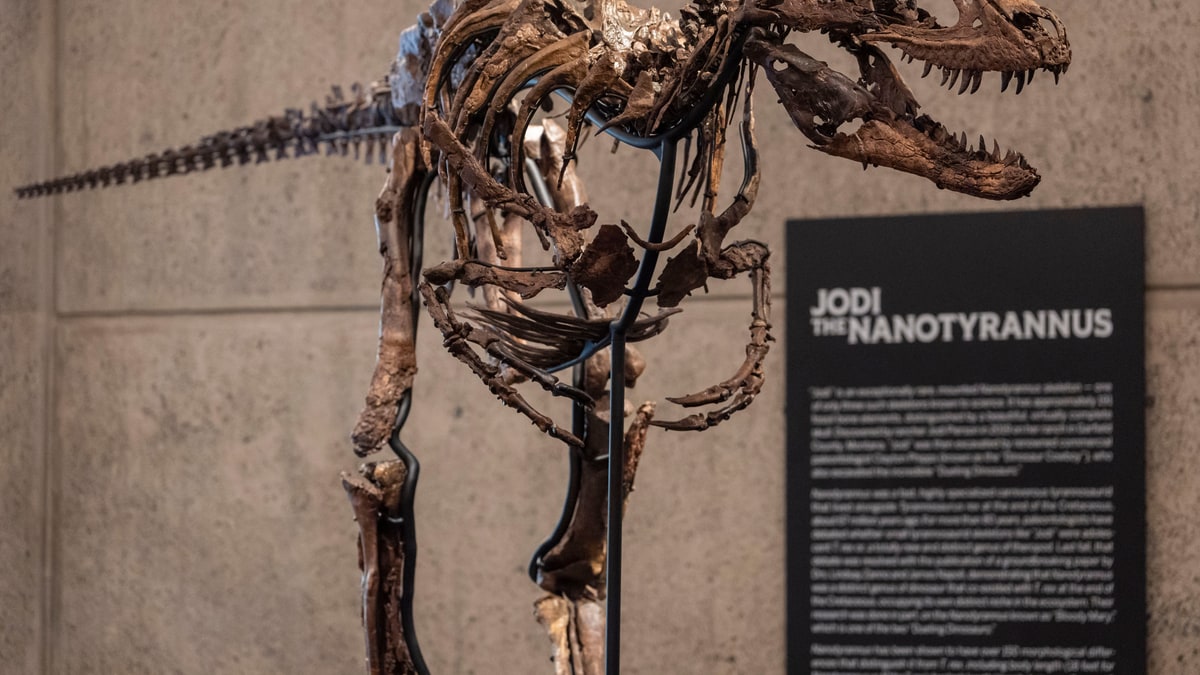
A dinosaur most scientists were still arguing about a few years ago has just become the second most expensive fossil ever sold. Jodi, a Nanotyrannus skeleton, went for $47.3 million (about Rs13 billion) at Sotheby’s in New York on Tuesday, 27 October, after 12 minutes of bidding between six parties, the BBC reported. Sotheby’s had put the estimate at $6 million to $9 million.
That is why “nanotyrannus” climbed Google Trends in Pakistan overnight. Here is the short explainer.
What is Nanotyrannus?
For decades, the few skeletons of this animal were treated as teenage Tyrannosaurus rex. Palaeontologist Megan Jacobs of the University of Portsmouth told BBC Radio 4 it was long thought to be “sort of a teenager of T. rex”, but it is smaller and more slender, with blade-like teeth for slicing meat.
The argument was settled in October 2025, when researchers Lindsay Zanno and James Napoli published work showing Nanotyrannus was a separate, fully grown animal. Growth rings in the bones, AP reported, showed these were adults, not youngsters. The two lived side by side about 67 million years ago, so the T. rex had a smaller, quicker relative hunting in the same land.
Who is Jodi?
The skeleton is named after Jodi Pierson, a Montana rancher who found it on her land in 2019, in the Hell Creek Formation. Commercial palaeontologist Clayton Phipps dug it out. AP describes it as about 2 metres tall and nearly 6 metres long, almost 70% complete, with a nearly complete skull and a jaw holding around 50 teeth. (The BBC gave its height as roughly 3 metres; mounted skeletons are often measured differently.)
Only three Nanotyrannus skeletons are known. One is in the famous “Dueling Dinosaurs” fossil at the North Carolina Museum of Natural Sciences, locked in a fight with a Triceratops, and another is at the Burpee Museum in Illinois. Neither is for sale. Jodi was the only one a private buyer could get, and the buyer’s name has not been made public.
Why are scientists unhappy?
Because the people who most need to study it may never see it again. Prof Steve Brusatte of the University of Edinburgh told the BBC it was “harrowing” to think one of the best skeletons could vanish “into the vaults of a collector” just as science has confirmed the animal is real. Stuart Sumida, president of the Society of Vertebrate Paleontology, told AP that peer-reviewed studies cannot be published on specimens that are not held in public trust.
The other side has a point too. Sotheby’s science head Cassandra Hatton told AP that private diggers who spend their own money are needed to find these fossils at all. Jacobs said she did not begrudge the sellers, and expects many such skeletons to reach museums eventually.
Why the prices keep rising
Sotheby’s sold a T. rex called Gus for a record $50.1 million in July, and a Stegosaurus named Apex for $44.6 million in July 2024. Dinosaurs have become trophy assets for the very rich, which is exactly what worries museums that cannot match those bids.
Pakistan has a dinosaur story of its own, by the way: the Geological Survey of Pakistan has reported fossils of long-necked sauropods and meat-eaters from the Vitakri area of Barkhan, Balochistan, from roughly the same age as Jodi. None of those bones is going to auction, which is how most palaeontologists would like it.
What to watch next: whether the buyer lends Jodi to a museum. That single decision decides whether this was a sale or a disappearance.
Sources
- BBC News: Nanotyrannus skeleton sells for $47.3m in New York auction
- NBC New York (AP): Rare fossil of T. rex cousin goes on display in NYC before auction
- Newser: Dinosaur's price skyrocketed in 12 'thrilling' minutes of bidding
- Sindh University Research Journal: dinosaur fossils of the Vitakri area, Balochistan
This story was researched and drafted with AI assistance, then checked and edited by our editor before publishing.